
Shared coversations, to shared meals: This is the Breakfast Club
By Aria Nguyen
Stepping through the glass door of the diner, you are greeted by the familiar scent of coffee and buttered toast, along with the quick steps of busy servers carrying trays stacked high with pancakes, eggs, and other staple breakfast items.
What may look like a “normal” Monday morning for most people at a local Denny’s is much more for some.
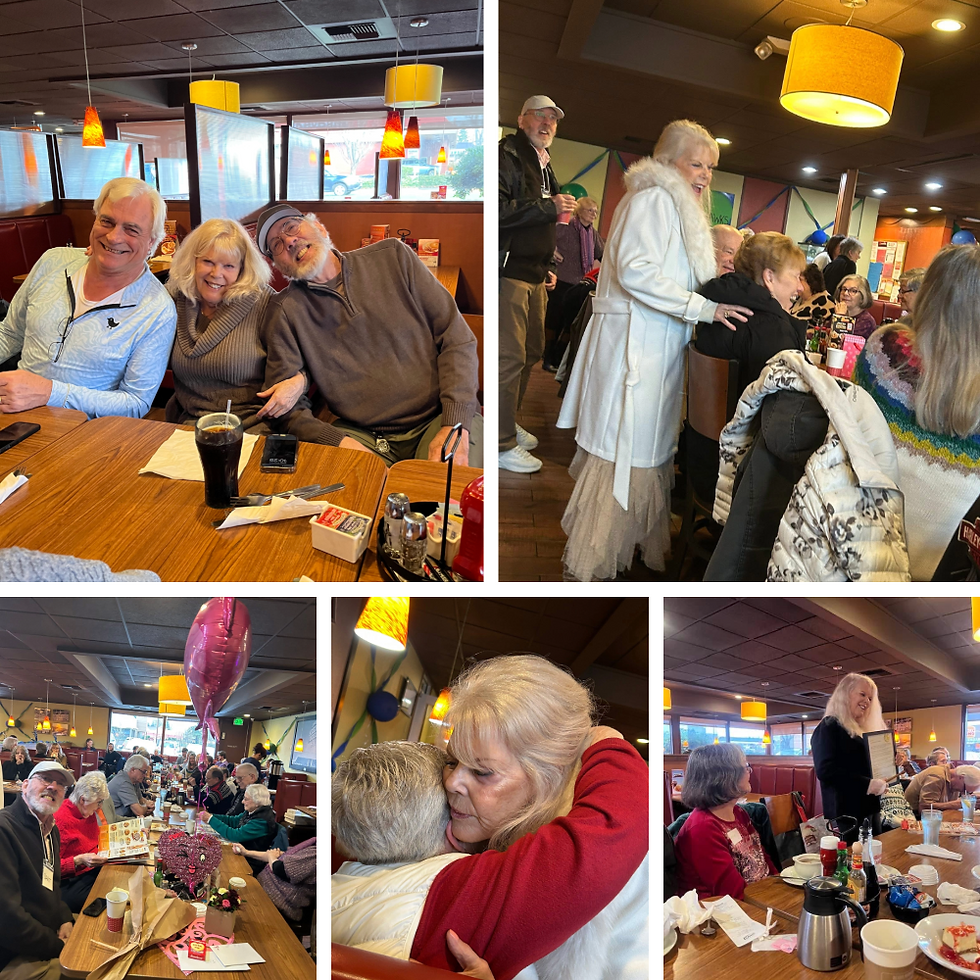
As you take a step deeper, in the middle of the room, you’ll see what are supposed to be seven individual tables pushed together to make one long seating arrangement.
Every chair is taken.
This is the Breakfast Club, a dementia-friendly gathering often facilitated by Dementia Support Northwest (DSNW) staff and volunteers. Attendees are caregivers and their loved ones.
A person who cares
The program was created by Patti, whose husband started experiencing difficulties with his memory after multiple back surgeries. Despite her own journey with dementia, Patti has dedicated her time to helping others experiencing similar situations.
“Patti is an unwavering good spirit,” Howard, a longtime group member, said. “So, she helps everybody to a fault. She can’t help herself from helping people; she’s been like that her whole life.”
Howard started attending DSNW’s online caregiver support groups on Thursdays. There, Howard said he heard about the Breakfast Club and decided to bring his wife, Marlene.
“There were six or eight people here [at the time, but] it was an instant community,” he said. “Patti made sure of that, because she’s Patti.”
The Breakfast Club became a safe space he could bring Marlene to, according to Howard.
“She was comfortable here. When we first came, she could still speak, but not very much. But eventually she couldn't,” Howard said. “It was good for [Marlene] to be here, because she would make eye contact with people, and you could tell she was trying to be here -- it was awesome. So, for me, it was just one more relief spot to bring her to be comfortable.”
Even after his wife’s passing, Howard said he still feels welcomed.
“This breakfast club thing is just fantastic, and it's just a nice community, and I feel like I can still come here...and not be uncomfortable,” he said.
He attributes most of this acceptance to Patti.
“She just made it comfortable; she made it comfortable for everybody that comes here,” he said.
Suzanne was another person seeking support after her husband’s Alzheimer's diagnosis. Similar to Howard, she was directed to the Breakfast Club through an outside program.
“It was a perfect fit for us,” Suzanne said.
She explained that at the time, most of the men attending were named Mike.
“So, I could always remember everybody’s names,” she chuckled.
More than names, Suzanne said it was a place for couples where guys could connect, and women would meet as well, making it easy to talk about whatever they wanted.
“It’s just like a friendship,” she said. “We're going on the same journey -- it's not the same completely -- but a lot of the same things occur, and it’s somebody we can talk to without having to explain everything.”
On top of that, the environment made the group enjoyable, Suzanne said.
“Patti was such a force of nature when I met her, and she still is, and she would get everybody laughing when I first met her,” Suzanne said. “And it just made it a lot of fun.”
From a few to many
Bart, another longtime Breakfast Club member, committed to driving over 30 minutes to get to Denny’s every Monday while he and his wife lived in Sedro-Wooley. He adds that Breakfast Club is a time for caregivers and care partners to relax, even just for a short period of time.
“They can get outside of themselves and not worry about their partner, themselves, or their mom, dad, whoever has the disease and gives them a chance to smile and laugh and take the burden off a little bit,” Bart said.
The Breakfast Club continues to grow, going from a few people in the back bar of the Bellingham Denny's to averaging 20 people in attendance each week.
"We're not just strangers in a restaurant. It's a family group now," Suzanne said, reflecting on why she continues to show up every Monday.
Coming full circle
Despite the increased success of the Breakfast Club and other programs and events DSNW has created over the years, founder Josselyn Winslow said she and her husband, Frank, did not imagine anything when it came to the organization.
"I think it was just like everybody when you're faced with dementia," Winslow said.
Winslow noticed her own mother's "little confusions" while they were living in Germany.
"I was a kid, you know, you practiced your spelling lists, and I could never spell words," Winslow said. "[My mother] always knew how to spell everything right; she was just really good. She was kind of the world's best secretary, but] she came on one day, and she said, 'You know, I've been having some problems.'"
Time passed on, and more things continued, such as a forgotten purse and keys, unable to tell which slipper was right or left, as Winslow described.
"We were seeing these things that were, you wonder about it, and then they're not big, so you just sort of forget about it," she said.
In the early 80s, Winslow's mother was diagnosed with Alzheimer's. Winslow and Frank, along with others such as Janet Willie -- a mental health professional -- decided to start a support group.
Even after Willie left, Winslow said they continued to run the group because dementia was "an issue" they "really needed to deal with."
The Alzheimer Society of Washington came to light in 1983, started with a few people around a kitchen table, as noted by DSNW. Now, half a dozen tables are needed for the Breakfast Club attendees who continue to show up for support, and to give their support.
"You just help people help themselves by bringing them together," Winslow said. "So it's just wonderful. It's beautiful."
____
The Breakfast Club is hosted every Monday at 10 am at the local Denny's on the Guide Meridian. These are shared experiences from those who attend and love being there. Not everyone may have the same experiences. We note this is a dementia-friendly event, so discussions of dementia should not occur unless done privately.
We'd like to thank Patti for creating this space where people can laugh, smile, and be in the moment with their loved ones and friends.


Comments